


Therapy FAQs: Fees, What to Expect & Common Questions
What To Expect
Starting therapy can feel like a lot. I've made the process as predictable as possible. No surprises, no guessing what comes next. Here's exactly how it works:
1
Free 20-Minute Consultation
The first step is to see if we're a good fit by booking a free 20-minute consultation call (video or phone — your choice). We'll talk about what's going on and how I may be able to help. No pressure to commit, no need to have the right words ready.
2
Complete Intake Paperwork
Once we've decided to work together, I'll send you a link to my secure client portal to complete intake paperwork. It takes about 20 minutes, and you can do it from home, at your own pace. This gives me a better understanding of you and what you need before we ever sit down together.
3
Intake Session/Therapy Plan
We'll meet for your first session in person or online, depending on your location and preference. We'll talk about your history, what's going on now, and set priorities for therapy. Then we'll decide on session frequency together and book your next appointment.
Sliding Scale Fee Structure for Therapy
I work with a limited number of clients at a time so I can show up for you the way you deserve—focused, energized and grounded. I use a 3-tiered sliding scale fee structure, which allows me to sustainably accommodate clients with different levels of financial resources.
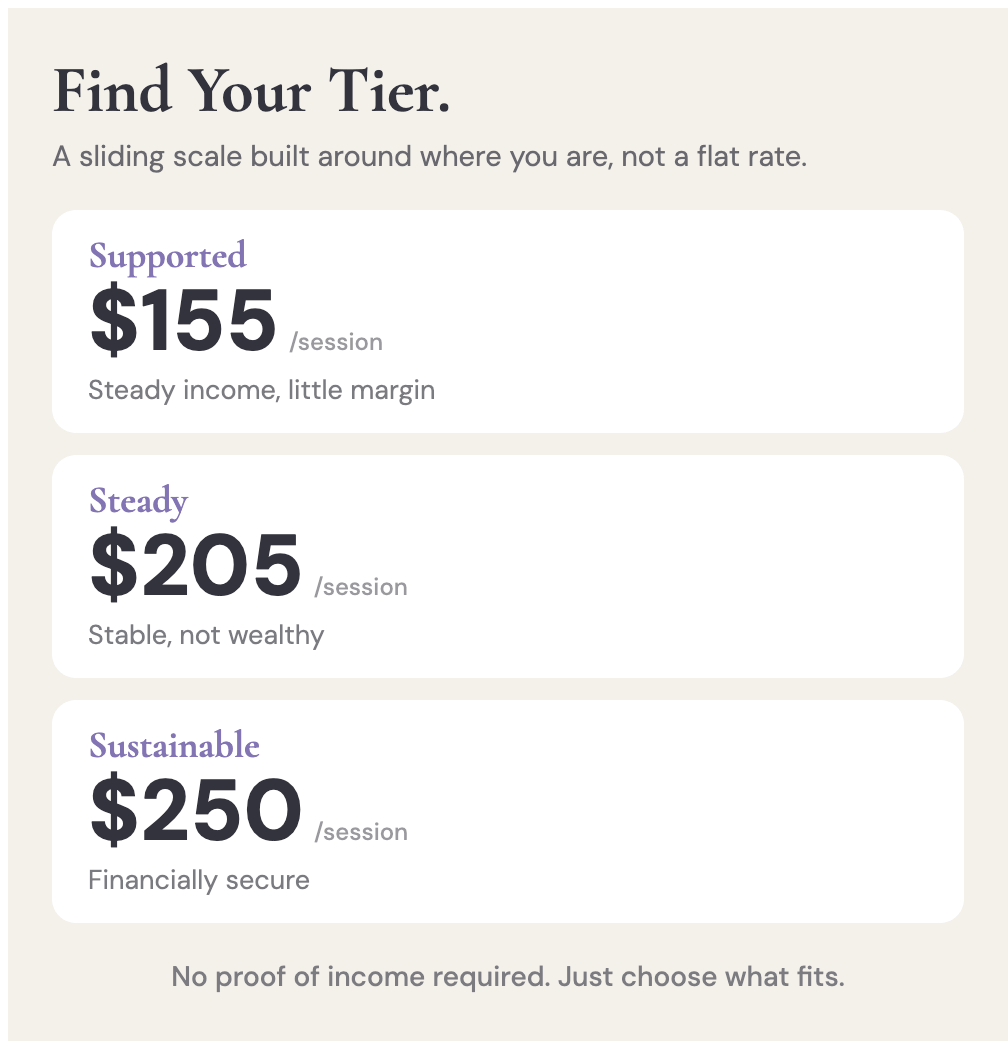
Supported Tier - $155 / 55 min. Session
You’re doing the best you can with a limited financial margin. You may earn too much to qualify for assistance, but not enough to feel secure. Therapy is a commitment, and likely means giving something else up to make it happen.
This tier applies if:
You have a steady income but little to no extra at the end of each month
You rely on a single income or support others financially (e.g., kids, aging parents)
If you were to lose your job, you would need to find other employment immediately
Your support system cannot offer financial assistance
You may carry high-interest credit card debt, medical bills, and/or lingering student loans
Vacations are rare or involve staying with family to reduce costs
Dining out, self-care, or even medical appointments are delayed or carefully rationed
Therapy is an important investment, but requires budgeting, planning, or sacrifice
Steady Tier - $205 / 55 min. Session
You’re not wealthy, but you’re steady. You can pay for therapy without hardship, though you still make intentional choices about how and where to spend. You may have debt, but it’s manageable, and you have at least some financial or structural support behind you.
This tier applies if:
You live in a dual-income household or have a salary that covers both needs and modest wants
If you were to lose your job, you could sustain your life with some adjustments for 3 months
You’re repaying student loans, a mortgage, or car payments, but none feel overwhelming
You can budget for vacations, eat out regularly, and invest in occasional extras like a gym membership or classes
You’ve got a small emergency fund and some health or retirement benefits
You don’t receive financial support from family, but you don’t need to give much either
You can access healthcare, take sick days, and get time off when needed
Therapy fits into your life as part of your ongoing personal growth and wellness routine
Sustainable Tier - $250 / 55 min. Session
You’re financially stable. You own your home or have stable long-term housing. You have some savings, some retirement contributions, and the day-to-day pressure of survival isn’t part of your life. Therapy is one of several things you can afford for your wellbeing.
This tier applies if:
You own a home (with an active mortgage) or have stable, long-term housing
You have an emergency fund covering at least three to six months of expenses
If you were to lose your job, you could maintain your lifestyle for six months or more before adjustments were needed
You can take an annual vacation, eat out regularly, and afford the occasional larger purchase without going into debt
You have employer-provided healthcare with reasonable co-pays, paid time off, and retirement contributions
You’re on track with debt repayment and not carrying significant high-interest debt
You have some discretionary income for self-care, fitness, classes, or other forms of personal investment
Therapy fits in your monthly budget alongside other wellness routines
What if 55 minutes isn't enough?
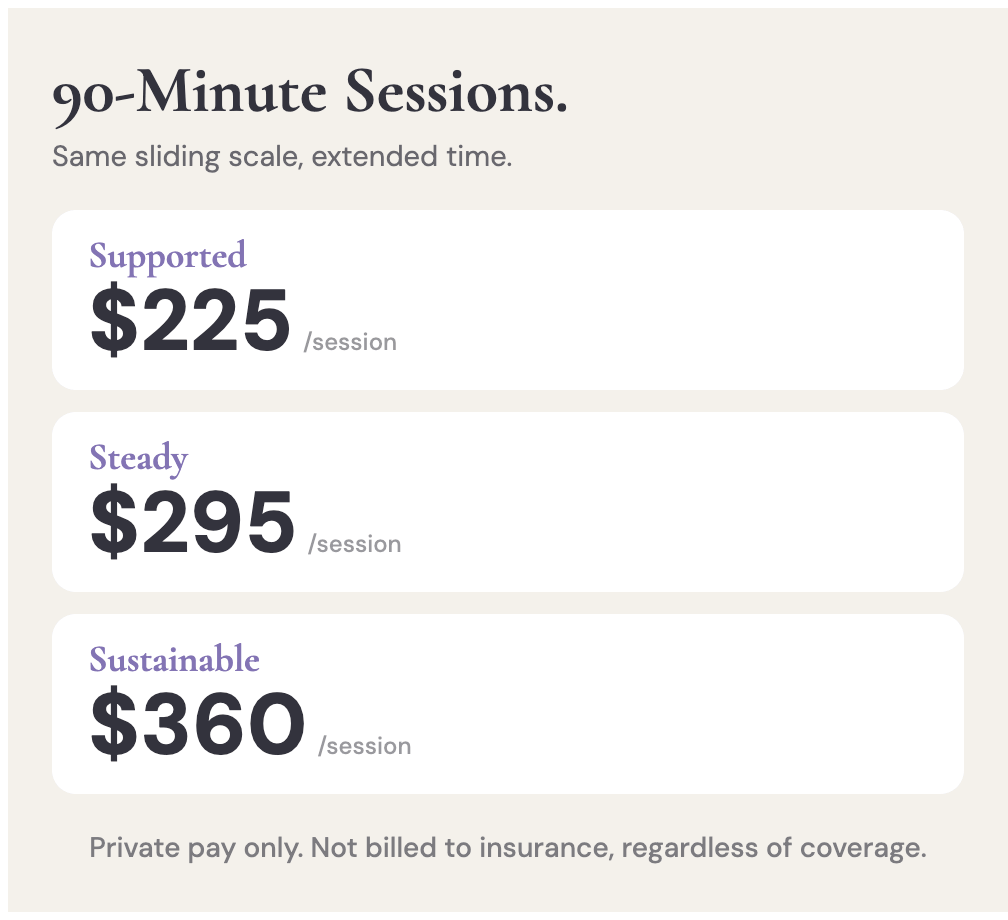
Some weeks, an hour isn't quite enough room to get into what actually needs attention, and having to stop mid-thought to pick it back up next week can be its own kind of frustrating. That's why I also offer 90-minute sessions.
There are two ways clients use them:
As an occasional deep dive. For a week that needs more space, whether we're working through something complex or you just have more to bring than usual.
As a standing option. If a weekly or every-other-week hour isn't realistic for you right now, whether that's your schedule, distance, or budget, a longer session on a less frequent basis can be a way to keep doing meaningful work without needing to show up as often.
Either way, it's not an upsell. It's a different shape for the same work, one that can end up costing less over time if it means fewer total sessions to get where you're going. If you think a 90-minute session might be a better fit than our usual pace, it's worth bringing up during your consultation.
Insurance
I'm in-network with Cigna, Optum, and United Healthcare for standard sessions. However, 90-minute sessions are a private-pay option and are not billed to insurance, regardless of your coverage. If you're paying out of pocket for standard 55-minute sessions, the sliding scale above applies; if you're using insurance, your plan's copay or coinsurance applies to 55-minute sessions, per your benefits.
I feel strongly that your mental health care should be between you and your therapist, and I’ll be getting off of insurance panels later in 2026. I'll give you at least 60 days' notice before that happens.
I understand that using health insurance is a necessity for some. If you want to use your out-of-network benefits to help pay for therapy, I’ll provide a superbill (monthly statement) that you can submit to your insurance company. These benefits are specific to your plan, and reimbursement requires that I give you a mental health diagnosis.
I've partnered with Thrizer to make using your out-of-network benefits super easy — you can check your eligibility here.
Frequently Asked Questions
You may have questions. Here are the ones I’m asked most.
-
If you're in the Baton Rouge area, we can meet in person or online. I offer online therapy across Louisiana, Florida, and Virginia.
Online sessions happen via a HIPAA-compliant, encrypted video platform. Just get to a private space and click the link that's emailed to you before your session. Earbuds can help with privacy and distractions.
For many of my neurodivergent clients, telehealth is actually the better sensory fit — your own lighting, your own chair, your own space. Either works.
-
I use a 3-tiered sliding scale, which depends on your level of financial resources. If you’d like to use your out-of-network insurance benefits, I’ll give you a monthly superbill for your visits, or you can let Thrizer handle it for you.
All clients keep a credit card on file via a secure site integrated with my practice management system. Sessions are charged the day of service. You can also use a health savings account (HSA) if you have one with your insurance plan.
Every self-pay client receives a Good Faith Estimate, so there are no financial surprises.
Feel free to contact me if you have questions about fees. -
Currently I accept Cigna, Optum, and United Healthcare through a company called Alma, though that will change in the coming months as I transition to a fully private-pay practice.
If you use out-of-network benefits, you may be able to get reimbursed for our work together. I can provide a superbill to submit to your insurance, or Thrizer can handle everything for you.
-
No. As an LCSW, formal autism and ADHD testing is outside my scope. I work with women who are diagnosed, self-diagnosed, or still exploring — you don't need a label to start. If you decide you want a formal evaluation, I'm happy to refer you to neuropsychologists in your state who do testing.
-
Yes — and you're in good company. Many of the women I work with arrive without either label. Some are just starting to wonder about autism or AuDHD; some are still asking "was it actually that bad?" The not-knowing is often exactly where we start. You don't need to have anything figured out before your first session.
-
This isn't a place where you have to keep masking. In person: I don't use the overhead light, I can adjust the blinds, and I have fidgets available (or bring your own). Online: dim your lights, turn off your video, sit on the floor, skip eye contact, take silences, ask me to repeat things or be more direct. Stimming is welcome. So is bluntness. So is needing extra time to find the words.
-
I'm not the best therapist for everyone, and I don't treat every mental health problem there is. I know who I do my best work with, and I have specialized training in the issues I treat — including neurodiversity-affirming care. I also have 25 years of experience as a therapist, lived experience as an AuDHD woman, and nearly 50 years of experience as a human.
I value authenticity, humor, and safety, and I want you to feel comfortable showing up as yourself. If you use colorful language, go for it. Dress comfortably and bring your fidget, blanket, or favorite beverage. Pets are welcome too — just check with me first before bringing one to an in-person session.
-
Yes! The Untangling Intensive is a nervous-system friendly, half-day session for autistic, AuDHD (diagnosed or self-identified) women who want to do focused work around emotional abuse, masking and burnout.
-
The first step is to book a free 20-minute consultation call. It gives us a chance to talk about what you're looking for, answer your questions, and see if we're a good fit. If we decide to move forward, we'll schedule your first session from there. You can schedule your consultation here.
-
The cancellation fee is 100% of your session fee for cancellations with less than 48 hours' notice.
The client portal is available 24/7, so you can reschedule without playing phone tag. If you need to cancel with less than 48 hours' notice, please call me or send a message through the portal.
Note: You are NOT financially responsible for any cancellations initiated by me.
-
Individual sessions are 55 minutes and typically held weekly or bi-weekly, depending on your needs and goals.
Extended therapy sessions are 90 minutes.
Group therapy sessions are usually 90 minutes and meet weekly for 8–12 weeks.
-
That depends. Some clients make significant progress in 6–12 sessions; others need more time — especially when we're untangling years of masking and relational trauma at a pace your nervous system can actually handle.
I don't want you to be in therapy forever. We'll work efficiently to get you feeling better and back to living your life.
Still have questions?
If you don't see your questions answered here, please send me a message or call 225.244.6163. I respond within 48 hours, Monday - Thursday. I'm also happy to answer anything during your free 20-min. consultation call.