If you're a woman who's just starting to wonder if you're autistic, late-identified autism in women therapy is a place to make sense of your whole life with someone who gets it. You don't need a diagnosis to start, and you don't need to have it all figured out. Your first session is mostly us getting to know each other, and you set the pace.
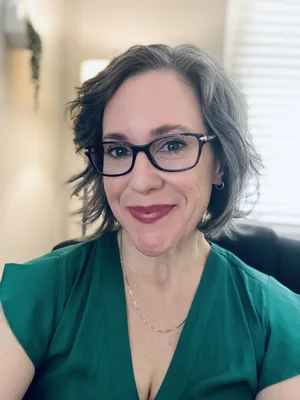
I'm Amanda Morris, a Licensed Clinical Social Worker (LCSW) in Louisiana, Florida, and Virginia. I'm a trauma-informed, neurodiversity-affirming therapist, trained in Accelerated Resolution Therapy (ART), and a Certified Financial Social Worker. I'm also an AuDHD woman myself, so I won't be surprised by much. I see clients in person in Baton Rouge and by telehealth across the state, including women in New Orleans.

What does "late-identified autism" mean for women?
It means you're realizing you're autistic as an adult, often in your 30s, 40s, or later. Research with late-diagnosed women found that many were missed as girls because their autism didn't look like what professionals expected (Bargiela et al., 2016). They learned to watch, copy, and blend in. That's called masking.
Masking works, until it doesn't. Many women find out after something breaks: a job, a relationship, or their health.
Some of the women I work with have a formal diagnosis. Some are self-identified. Some are just starting to wonder. All of those are valid places to begin.
Do I need an autism diagnosis to start therapy?
No. I don't diagnose autism or ADHD, and you don't need a diagnosis to work with me.
What I do is help you understand your life through a neurodiversity-affirming lens. If you decide you want a formal assessment later, we can talk about what that might look like and where to start looking.
What will my first session actually be like?
Less scary than you're picturing. Here's what to know going in:
You can stim and fidget. Move however your body needs to. If we meet by telehealth, I do ask that you keep your camera on. Facial expressions and body language give me important context as your therapist. Headphones are fine on telehealth as long as you're using them to hear me.
In person, the room is set up for you. We have white noise machines in the hallway to cut down on distracting sounds and keep sessions confidential, so headphones stay off during in-person sessions.
You don't have to tell your whole story. We start where you want to start. Some people lead with the relationship. Some lead with burnout. Some just say, "I don't know why I'm here." All good.
You can tell me what you need. If you think better in writing, or need me to slow down, or want more direct questions, say so. I'll adjust.
You get to ask me questions too. You're allowed to check whether it feels right.
In my work with clients, something I see a lot in first sessions is worry about the "right" way to show up to therapy. There isn't one. I want you to be yourself. Wear whatever feels comfortable. Talk how you usually talk, curse words included. And feel free to bring a non-alcoholic drink or a snack you like.
Why do so many late-identified autistic women end up in emotionally abusive relationships?
Let me be really clear: being autistic does not cause abuse. The person doing the harm is responsible for the harm.
But some autistic traits can be easy for a controlling person to use against you. Things like:
Taking people at their word
Doubting your own read on a situation because you've been told you "get it wrong" your whole life
Working really hard to keep the peace
Struggling to name what's happening in the moment and only making sense of it days later
None of those are flaws. They're traits someone chose to take advantage of. In recovery, a lot of them turn into strengths, like your loyalty to the truth and your eye for patterns.
"He never hit me." So is it really abuse?
In my work with clients, this is something I hear a lot: "He never hit me or put his hands on me." It's usually said as a reason why what happened doesn't count.
Emotional abuse is real abuse, even when there are no bruises. It can look like:
Calling you "too sensitive," "too much," or "crazy" when you react to how you're treated
Making you doubt your memory of what happened
Using your meltdowns, shutdowns, or sensory needs against you
Controlling the money, or making you feel stupid about it
Cutting you off from friends or family, a little at a time
That money piece matters a lot to me. As a financial social worker, I know financial control is a common part of abuse, and it rarely gets named. In one study of abuse survivors, 94% had experienced some form of economic abuse (Postmus et al., 2012).
You don't have to decide today whether to call it abuse. Plenty of women come in still in the relationship and still unsure. That's okay. We can figure it out together.
If you want to talk it through with someone today, the National Domestic Violence Hotline is free, confidential, and open 24/7. You can call 1-800-799-7233, text START to 88788, or chat with an advocate on their website.
What is autistic burnout, and can therapy help?
Autistic burnout is a deep exhaustion that can come from years of masking and pushing past your limits. It's not just being tired. Researchers describe it as chronic exhaustion, losing skills you used to have, and a lower tolerance for sensory input (Raymaker et al., 2020). It can feel like hitting a wall you can't climb over.
Therapy can help you understand what's draining you, lower the demands where you can, and stop blaming yourself for needing rest. Many people find that just having words for it is a relief. I treat burnout through trauma-informed, nervous-system-focused work, not quick fixes.
How does therapy for late-identified autistic women work in my practice?
There's more than one way to work with me, because one size definitely does not fit all brains.
Individual therapy: Weekly or every other week, by telehealth.
The Unmasking Group: A weekly online therapy group for autistic, AuDHD, and ADHD women.
The Burnout Recovery Intensive: A half-day intensive for when weekly sessions feel too slow, or you want focused time on one big thing.
Accelerated Resolution Therapy (ART): A structured trauma therapy that can help with painful memories without having to retell every detail.
I see clients in person in Baton Rouge and by telehealth anywhere in Louisiana, Florida, or Virginia. So whether you're in New Orleans, Baton Rouge, or a tiny town nobody's heard of, we can work together.
Is this a good fit for you?
This approach is often a good fit if you:
Are a woman 21 or older who's autistic, AuDHD, or wondering if you might be
Are dealing with the aftermath of emotional abuse or a controlling relationship, or are still in one
Feel burned out from years of masking
Live in Louisiana, Florida, or Virginia
Want a therapist who won't try to make you more "normal"
Something else might be a better fit if you:
Need a formal autism or ADHD assessment (I don't diagnose)
Are in crisis or need more support than weekly therapy can offer right now
Are looking for couples counseling with a partner who's harming you
Live outside Louisiana, Florida, and Virginia
If I'm not the right fit, I'll do my best to point you somewhere that is.
Frequently asked questions
Do I have to be formally diagnosed to work with you?
No. Self-identified and still-wondering women are welcome. I don't diagnose autism or ADHD, and I won't ask you to prove anything. We'll focus on what's going on in your life and what you want to change. If you decide you want a formal assessment later, we can talk through options together.
Do you see clients in person in New Orleans?
I only see clients in person in Baton Rouge. If you're in New Orleans, we can work together by telehealth, which means no drive, no waiting room, and no fluorescent lights. Many autistic women find sessions from home easier on their nervous system. Telehealth is open to anyone in Louisiana, Florida, or Virginia.
What if I'm still in the relationship?
That's okay, and you're welcome here. You don't need to have left, and you don't need to be ready to leave. Lots of women start therapy while they're still trying to figure out what's happening. We go at your pace, and you stay in charge of your decisions. My job is to help you see clearly.
What's the difference between the Unmasking Group and individual therapy?
Individual therapy is just you and me, focused on your story and your goals. The Unmasking Group is a weekly online group where you're with other autistic and AuDHD women who understand masking from the inside. Some people do one, some do both. We can talk about what fits during your free consult.
How do I know if it's autistic burnout or depression?
Autistic burnout and depression can look alike, and they can happen at the same time. Research suggests they're related but not the same thing (Raymaker et al., 2020; Bougoure et al., 2026). Burnout often calls for fewer demands and more rest, so it helps to know which one you're dealing with. That's something we can sort out together.
Ready when you are
If any of this sounds like you, I'd love to hear from you. Late-identified autism in women therapy doesn't have to be one more place where you mask. It can be a place to finally put the mask down, slowly and on your terms.
You can book a free 15-minute consult whenever you're ready. No pressure, no script. Just a chance to see if we click.
If you're in crisis, call or text 988 (the Suicide & Crisis Lifeline) or go to your nearest emergency room.
References
Bargiela, S., Steward, R., & Mandy, W. (2016). The experiences of late-diagnosed women with autism spectrum conditions: An investigation of the female autism phenotype. Journal of Autism and Developmental Disorders, 46(10), 3281–3294. https://doi.org/10.1007/s10803-016-2872-8
Bougoure, M., Zhuang, S., Brett, J. D., Maybery, M. T., English, M. C., Tan, D. W., & Magiati, I. (2026). Measuring autistic burnout: A psychometric validation of the AASPIRE Autistic Burnout Measure in autistic adults. Autism, 30(1), 20–36. https://doi.org/10.1177/13623613251355255
Postmus, J. L., Plummer, S.-B., McMahon, S., Murshid, N. S., & Kim, M. S. (2012). Understanding economic abuse in the lives of survivors. Journal of Interpersonal Violence, 27(3), 411–430. https://doi.org/10.1177/0886260511421669
Raymaker, D. M., Teo, A. R., Steckler, N. A., Lentz, B., Scharer, M., Delos Santos, A., Kapp, S. K., Hunter, M., Joyce, A., & Nicolaidis, C. (2020). "Having all of your internal resources exhausted beyond measure and being left with no clean-up crew": Defining autistic burnout. Autism in Adulthood, 2(2), 132–143. https://doi.org/10.1089/aut.2019.0079